

Black tourmaline in albite matrix with hyalite and minor fluorite
Black tourmaline in albite matrix with hyalite and minor fluorite
Couldn't load pickup availability
Locale: Erongo Mountain, Namibia
Approx dimensions: 5 x 3.25 x 3"
Approx weight: 603g
This is a great "hodgepodge" specimen, featuring a large cluster of botryoidal hyalite on a Dalmatian spotty matrix of white albite, black tourmaline, and smoky quartz. The crystals of black tourmaline, known as schorl, are well-formed and many have the 'Mercedes' termination characteristic of the Erongo region. A few small cubic fluorite crystals also spot the specimen.
Hyalite is a form of opal, which in turn is part of the broader quartz family. It displays botryoidal growth (bunches of “grape-like” round crystals) with a glossy high luster like a layer of bubbles. I think it looks like mermaid caviar! Hyalite turns "radioactive" green under UV light due to trace elements of uranium. Don’t worry though, it's not enough to expose you to radiation.
Hyalite can appear fluid with formations that look like the splash from a drip frozen in place, or as if the edge has been peeled up away from the quartz like a tutu. This specimen is a great example of that, the hyalite appearing as if it just splatted onto the matrix. The specimen also has an interesting snowball of small colorless needles atop the hyalite, which seem to have the same fluorescence as the hyalite—green in the core with icy blue needles poking out.
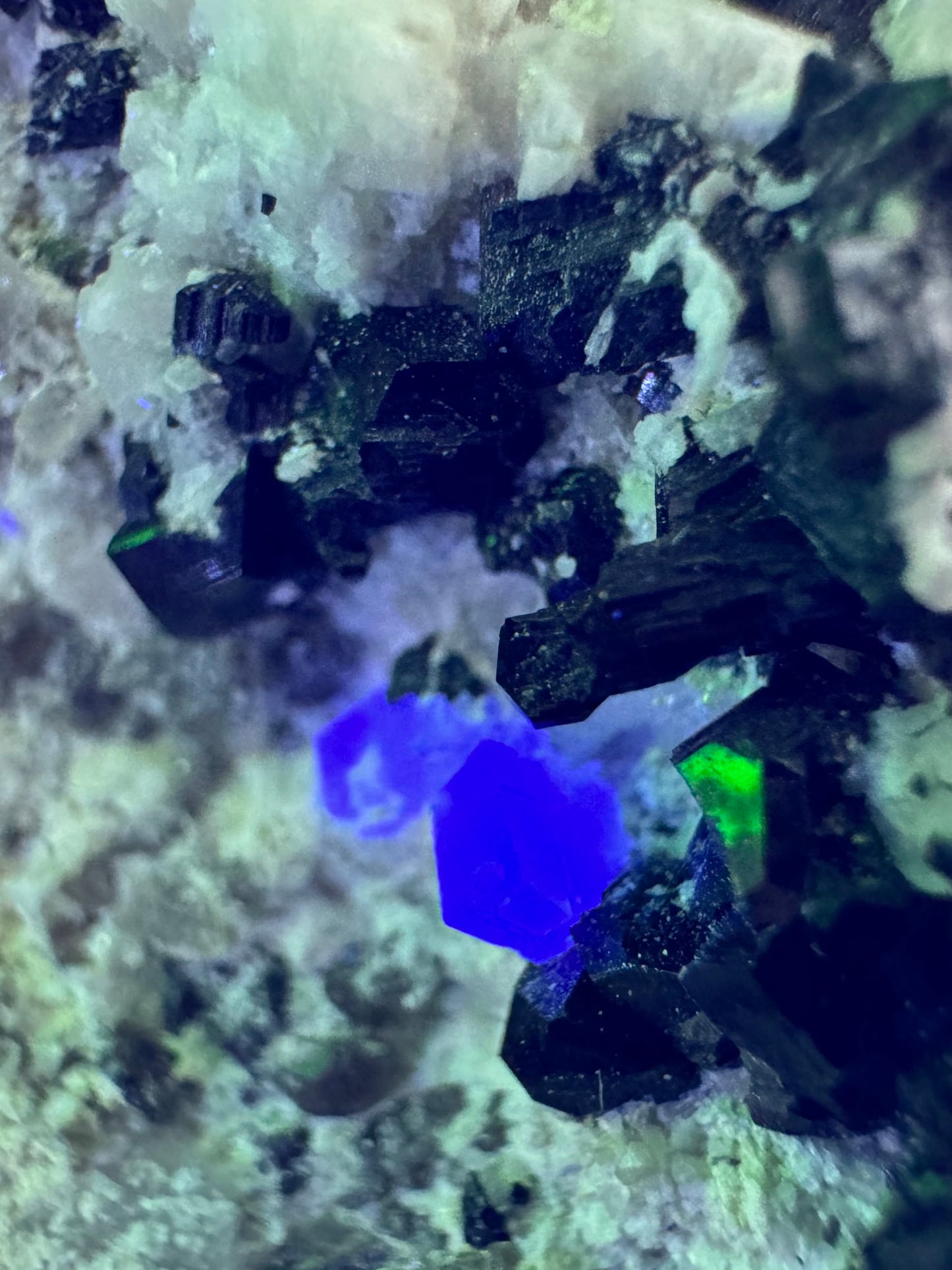
UV reactivity Hyalite is so strongly UV reactive that you can see it in sunlight. Under indoor lighting it is pale yellow to golden in color, but this specimen turns visibly greenish-yellow when exposed to the UV in sunlight. 395nm UV fluoresces a strong green, with an icy blue undertone. 365nm UV fluoresces a strong yellowish-green color, generally visible even in bright lighting. This wavelength also causes the fluorite to glow bright blue. No phosphorescence detected.