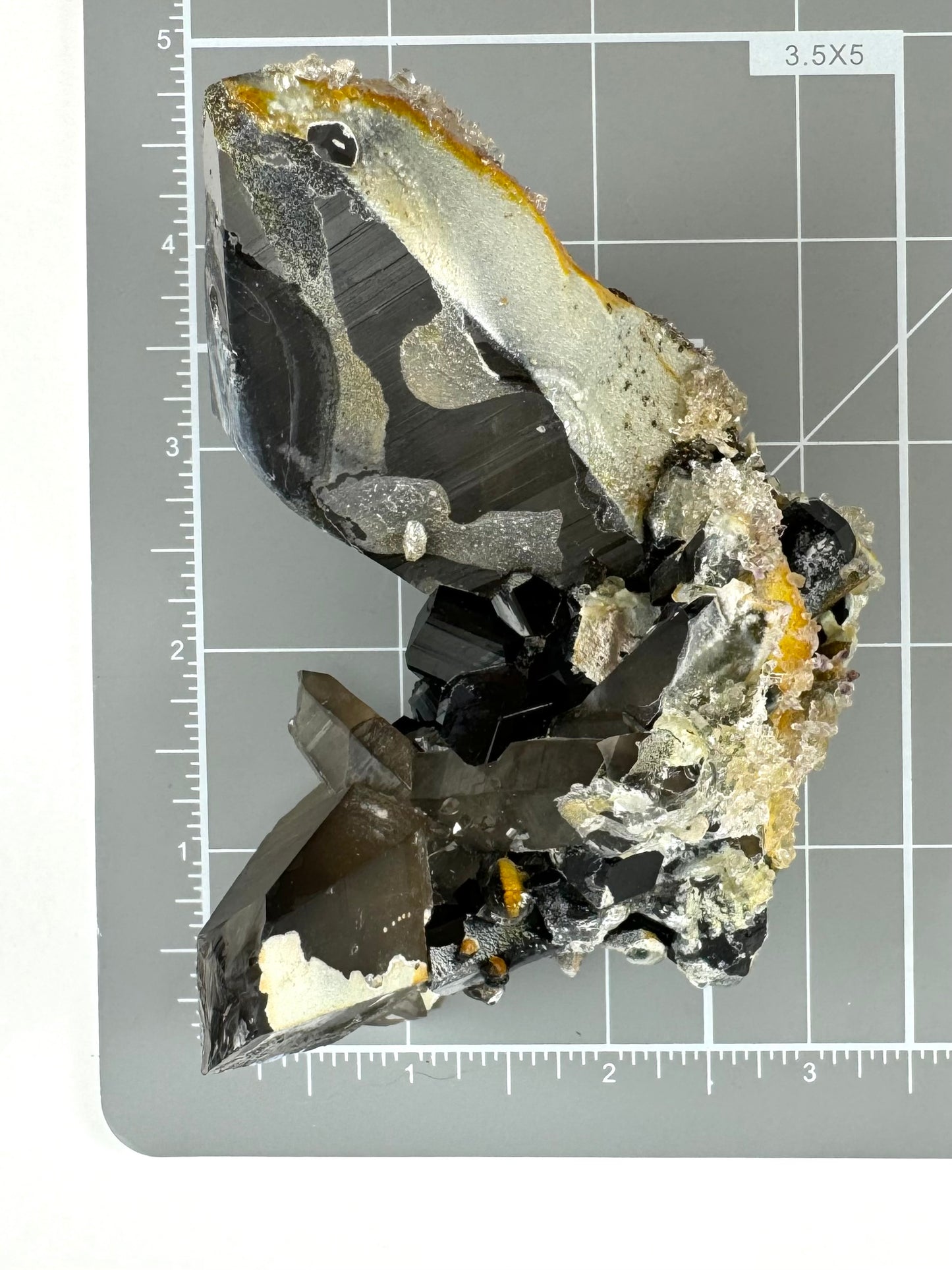


Smoky quartz and black tourmaline cluster with hyalite
Smoky quartz and black tourmaline cluster with hyalite
Couldn't load pickup availability
Locale: Erongo Mountain, Namibia
Approx dimensions: 3.5 x 2.5 x 2.5"
Approx weight: 320g
This Erongo specimen features a cluster of black tourmaline (schorl) between two chunky smoky quartz crystals, with a heavy coating of hyalite on the base and wrapping the larger quartz crystal. The glossy schorl crystals grow in short prisms with the classic trigonal 'Mercedes' termination characteristic of Erongo material.
Erongo smoky quartz typically grows bulky angular points like the main two crystals, with a flat surface luster caused by etching. The smoky quartz has good translucency, but appears dark due to the hyalite coating. Smoky quartz gets its dark coloration from trace elements that tint dark when the quartz is exposed to natural radiation. Don’t worry, the specimen can't expose you to radiation—even if the hyalite turns "radioactive" green under UV light due to trace elements of uranium. Paired with hyalite, the smoky quartz takes on a witchy appearance.
Hyalite is a form of opal, which in turn is part of the broader quartz family. Related minerals commonly grow together because they have similar requirements for growth: in this case, the availability of silica that is the basis for the quartz family. Growing conditions that initially produced quartz changed, and a later generation of growth deposited the less common hyalite on the specimen.
Hyalite displays botryoidal growth (bunches of “grape-like” round crystals) with a glossy high luster like a layer of bubbles. I think it looks like mermaid caviar! Hyalite can appear fluid with formations that look like the splash from a drip frozen in place, or as if the edge has been peeled up away from the quartz like a tutu.
All around the base there are fine icicle-like needles of crystals which I don't believe to be hyalite, but may simply be quartz. Some appear purple-capped like a miniature amethyst scepter. On other specimens the purple ends appear to have cubic forms, so these might also possibly be extremely small fluorite crystals.
UV reactivity Hyalite is so strongly UV reactive that you can see it in sunlight. Under indoor lighting it is pale yellow to golden in color, but turns visibly greenish yellow when exposed to the UV in sunlight. 395nm UV fluoresces a strong green, with an icy blue undertone. This specimen displays the dual-tone fluorescence especially well! In fact I forgot to take a picture showing the 365 reaction because I was so obsessed with how it looks under 395 light. 365nm UV fluoresces a strong yellowish-green color, generally visible even in bright lighting. No phosphorescence detected.