

Southwestern minerals mystery box
Southwestern minerals mystery box
Couldn't load pickup availability
Info on the main mineral specimens below!
▶ HOW IT WORKS you pick your main specimen, and the rest of the box will be filled with a mix of inexpensive minerals from the Southwestern U.S. and Mexico. Since I'm in Tucson, minerals from Arizona and our neighbor to the south, Mexico, will feature heavily.
▶ The mix is primarily mineral specimens with a few cut or polished materials (i.e. agates, geodes)
▶ The contents of the box are a mystery, but I won't leave you with a mystery identifying the minerals—labels are included.
▶ Locale known in many cases, and included on labels. Commonplace minerals like selenite and chrysocolla are less likely to include locale. Some minerals have also come from the estates of rockhounds or other circumstances where I know they were collected locally but unfortunately can't confirm origin!
▶ Possibilities include quartz, agate, jasper, chalcedony, geodes, selenite/gypsum, obsidian, calcite, petrified and fossilized wood, peridot/peridotite, feldspar, fluorite, adamite, serpentine, wulfenite, smithsonite, galena, stibnite, pyrite, chalcopyrite (natural, treated), native copper, copper minerals (chrysocolla, malachite, azurite, aurichalcite, rosasite, conichalcite...) and more!
MAIN SPECIMENS
OPTION A is hemimorphite with rosasite from the 79 Mine in Arizona. The hemimorphite has acicular growth that produces agate-like banding along broken edges. Pockets of hemimorphite line two sides of the matrix. The surface layer is a frosty translucent white spotted with deep teal spheres of rosasite; where spheres have fallen off, the hemimorphite has a light blue chrome-like surface. The third side is spotted with small spheres of hemimorphite like a colony of sea urchins. (Teensy spots of orange are likely wulfenite which is a known associate at this mine).
OPTION B is a classic example of a pocket of colorless bladed hemimorphite from the Mapimí region of Durango, Mexico. Colorless calcite rhombs hide at the base of the crystals, and tiny rose-tinted rhombs spot the hemimorphite blades—likely also calcite tinted with hematite. The reverse is a soft red limonite matrix that can/will stain surfaces (see: my hand).
OPTION C is vibrant aqua-blue aurichalcite with colorless calcite on matrix, from the Southwest Mine in Bisbee, Arizona. The aurichalcite has acicular (radial) growth, with fine needles filling nooks and cracks, and a few good poofballs spotting the surface. The calcite grew second, so many of the crystals have aurichalcite enclosed within. A fan of three calcite points with aurichalcite inside sits atop the specimen; the points have disordered forms, possibly a result of the aurichalcite interfering with growth.
OPTION D is a lovely example of chrysocolla from Arizona. A thin teal-blue layer of chrysocolla with faint reniform structure coats a piece of quartzite. The main face of the piece is spotted with small turquoise-blue spheroids with green cores, and a few dark navy blue spheres also in the mix (the latter may be goethite). A thin layer of chrysocolla coats the surface, creating a crackled pattern. The reverse and edges of the piece show some of the pattern, and the chrysocolla grows into the white quartzite, giving it light aqua-blue patches.
OPTION E is adamite on limonite matrix from the Ojuela Mine in the Mapimí region of Durango, Mexico. Several partial spheres composed of fanning adamite crystals—a classic growth form from this mine called 'pinwheels'—are tucked in a gap in the matrix. The crystals have nice yellow-green color and good translucency. Adamite is known for its electric green fluorescence; this specimen displays a strong yellow-green glow when exposed to 365nm UV light.
OPTION F is a properly ugly wulfenite specimen (believe me; I already kept one!) from the Ojuela Mine in the Mapimí region of Durango, Mexico. Dull mustard-brown octagonal tablets of wulfenite are scattered across a limonite matrix coated with shag-carpet-esque salmon-brown calcite. Calcite also lines the edges of several of the wulfenite crystals.
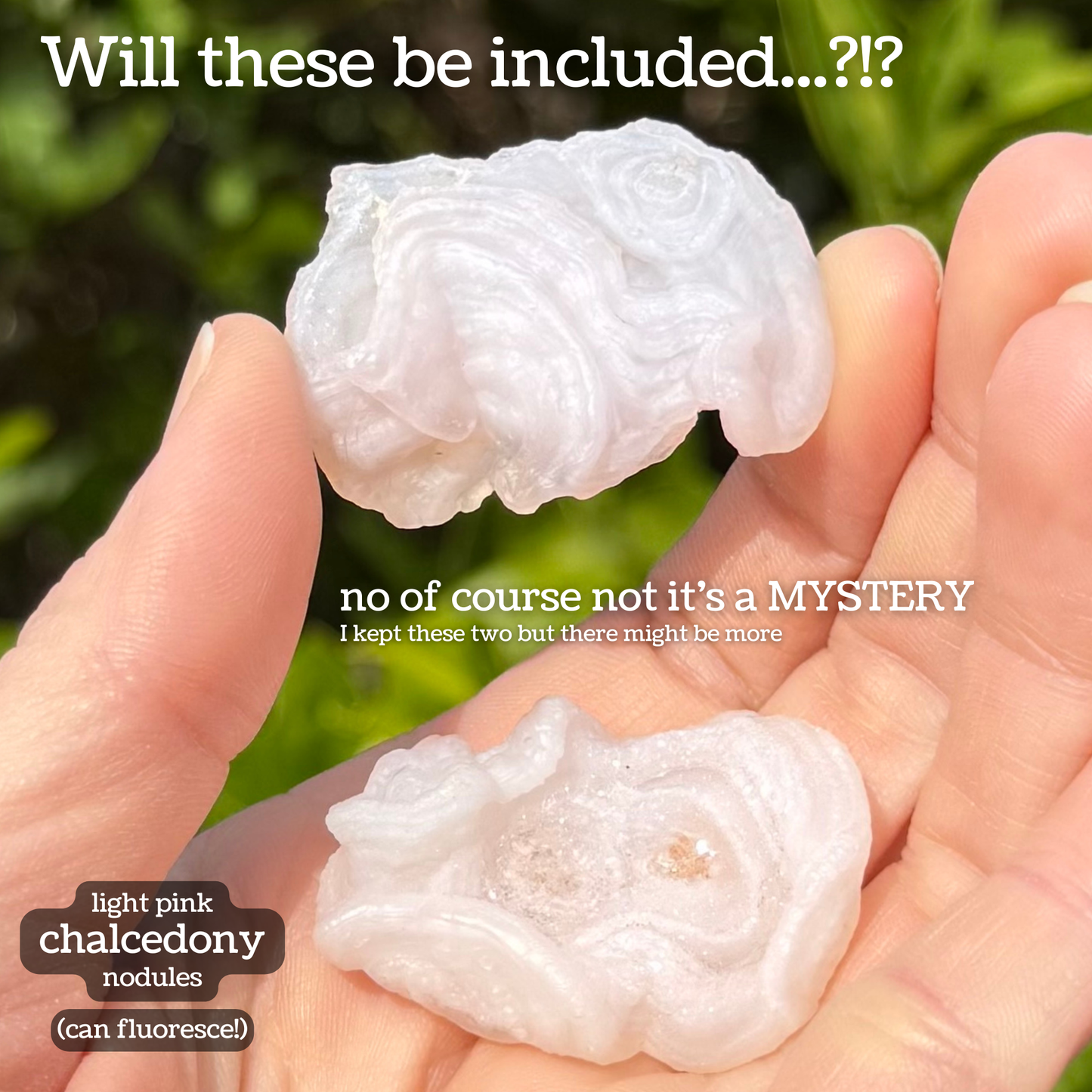
OPTION G is a pale pink chalcedony nodule. Pink chalcedony nodules, sometimes called "chalcedony desert roses," have been discovered across the southwest. Exact locality is unknown for this specimen but I suspect Round Mountain which is a somewhat prolific producer of Arizona material. The nodules typically have ropy, undulating, and botryoidal forms; this egg-like piece has ropy layers wrapped around a small hole, with bumpy edges. There are a couple of quartz flowers (sprays of small crystals) on the side and underside. This form of chalcedony often fluoresces; reaction is weak using 365nm, but much stronger under shorter wavelengths.
OPTION H is an unusual example of selenite collected from Utah's Great Salt Lake. The lake's water famously has higher salt content than sea water because evaporation concentrates the lake into a brine. Selenite is a mineral form of calcium sulfate (an inorganic salt) so crystals grow in the mud of the lake and can be collected from certain mud flats. The crystals are notable because they include fine particles of clay that can produce excellent growth patterns. The long straight edge of the piece is cleanly cleaved and provides a window into the crystal. Note that selenite should be kept dry; as a form of salt it can degrade similarly to halite, although it is less sensitive.
OPTION I is a Hot Pocket of malachite tucked inside a light-colored matrix, locale unknown (AZ-NM-MX region suspected). The specimen has rolling green hills of malachite with velvety luster. The radial banded structure is visible along the broken edges and has good chatoyancy. Several poofball formations dot the surface and edges, appearing composed of small blades of malachite.
OPTION J is amazonite from the Smoky Hawk Claim in Colorado famed for producing rich robin's egg blue crystals accompanied by near-black smoky quartz. This piece is a bit of a haphazard mishmash of fractured amazonite fused together by additional minerals including pale smoky quartz. The main face of amazonite is vivid teal-blue with slight translucency that gives the color a rich depth. Handle with some care; fractures are stable but susceptible to break under pressure.
OPTION K is technically a pseudomorph of calcite after ikaite better known as glendonite, but 'thinolite' is used for this specific regional form. Thinolite is a variety of tufa that grows in mineral-rich lakes of Nevada and California; this piece is from Washoe County, Nevada. A lot of tufa is knobby with a coral-like structure, but thinolite grows in clusters of porous four-sided spindles. The specimen fluoresces whitish under 365 nm UV light, with phosphorescence lingering for several seconds (with a quality UV light). CAUTION: BRITTLE!
OPTION L is a rhodochrosite thumbnail from the Santa Eulalia mining district of Mexico, which is known for its high-quality specimens. The rhodochrosite is opaque with muted pink color and glittery luster. The spherical forms grow over a botryoidal hisingerite matrix with a calcite interior (red fluorescence is visible under 365 nm UV). Includes 1.5" black acrylic base, affixed with GeoKrazy putty.